Polymarket Arbitrage: Live Opportunities Scanner (2026)
Published Updated
Polymarket arbitrage is a trade where you buy opposite sides of the same event on different venues – YES on one platform, NO on another (Polymarket, Kalshi, Opinion) for less than $1 combined. If the contracts resolve equivalently, one side pays $1, leaving a spread before fees and slippage.
What is Polymarket arbitrage
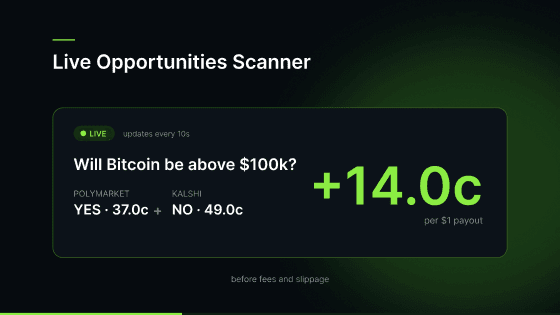
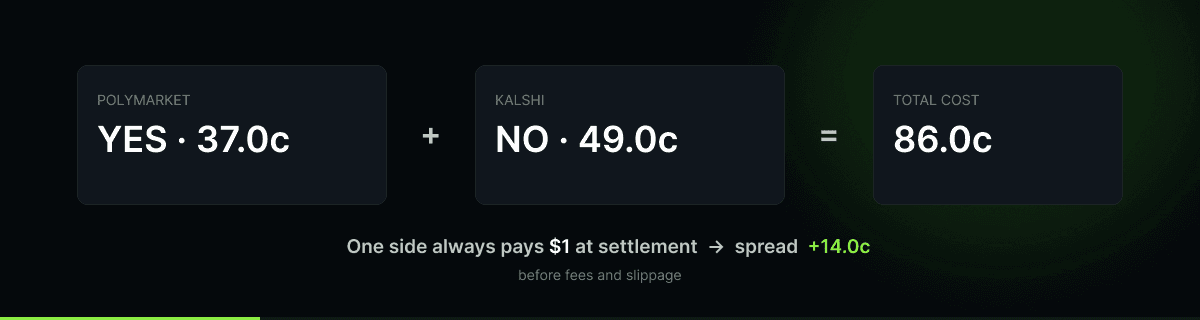
The easiest way to understand it is through a worked example. Say the market is “Will Bitcoin be above $100k?” The price of YES on Polymarket is 37.0¢. NO on Kalshi is trading at 49.0¢. You buy both. Your total cost is 86.0¢.
If both contracts use equivalent resolution criteria, one of them will pay out $1 at settlement: Bitcoin is either above $100k, or it is not. You pay 86.0¢ and receive $1 – this leaves a 14.0¢ spread per contract before fees and slippage.
If YES on one venue plus NO on another costs less than $1, that difference is your spread before fees and slippage once both orders are filled. The trade does not depend on predicting the event's outcome.
Why are these gaps there? This is for a number of reasons:
Fragmented liquidity
There are separate order books for each platform. Polymarket and Kalshi prices are independent.
Different user bases
Crypto-native traders may dominate one venue while a US retail crowd trades on another. Each group can price the same event a bit differently.
Resolution wording
There can be minor variations in the definition of the outcome in two markets of the same event. Traders take that uncertainty into account.
The difficult part is not the concept; it’s the speed. A few cents can make a difference in minutes – a manual price check on different venues is too slow. A prediction market arbitrage scanner can compare prices in real time and surface these routes the moment the combined cost drops below $1.
Live Polymarket arbitrage opportunities
The prediction market arbitrage scanner below shows live routes between Polymarket, Kalshi, and Opinion. Each card represents one route: buy YES at one venue, buy NO at another, at a combined price below $1. ArbLense shows the route – you place both trades on the venues yourself. The data is informational only.
Each route card has five numbers that matter:
Cost per contract
The price of both sides added together. For illustration, YES on Kalshi plus NO on Polymarket totals 57.7¢ per $1 payout; this is not a current quote.
Potential profit
The gap between the cost and the $1 payout. In this illustrative example, that is +42.3¢ per $1 payout before fees and slippage.
ROI
Spread divided by cost. The illustrative example gives 42.3 ÷ 57.7 × 100 = 73.3% ROI before fees and slippage.
Depth
How many contracts sit at the listed prices on each side of the book.
Resolves
The settlement date. A route that pays +42.0¢ but resolves in a year is a different trade than a route that pays +5.0¢ next week. Your money is locked until settlement, so the date is part of the math.
Depth is the aspect people skip. The price shown at the top of the book is not the price of your entire order. If the best NO price on Polymarket is 132 contracts, and you place an order for 500 contracts, the remaining 368 will be executed at worse prices. The spread you saw can shrink or vanish inside your own fill.
That is why the scanner shows a depth preview for both sides. Please check your size before ordering, as it is important to match the size of the book.
Remember that routes can disappear in minutes. You are not the only person who can see the gap. Other traders can close a spread once it has opened. Plus, each venue has its own price – one side can change while you fill the other. The spread only exists once both sides are filled, and only before fees and slippage.
Kalshi arbitrage: cross-platform routes
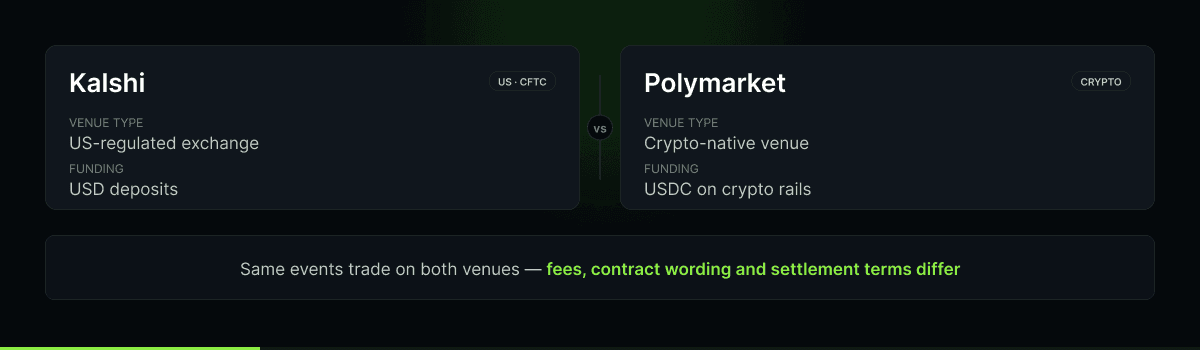
The deepest route pair in the scanner is Kalshi–Polymarket, with overlapping event contracts across both venues. Kalshi is a US-regulated exchange that supports dollar deposits, while Polymarket operates on crypto rails. Fees, contract wording, and settlement terms can all affect Kalshi arbitrage. See current routes and venue-specific details on the Kalshi–Polymarket arbitrage page.
Arbitrage strategies that still work
Here are the three main patterns the scanner picks up:
Cross-platform spreads
This is the classic setup. The same event is priced in a different way on Polymarket or Kalshi. YES plus NO can be bought for less than $1 combined. Weather and sports markets are frequent sources of these gaps.
Negative risk markets
In a multi-outcome market, the NO prices on all candidates can add up in your favor. You buy NO on every outcome. Since only one of them can win, the payouts on the losers cover the full position with room to spare. See live negative risk markets the scanner has found right now.
Internal inconsistencies
A multi-outcome event should sum to 100% – one of the outcomes must happen. When the listed prices add up above or below that, a gap is inside a single platform, with no second venue needed.
Each pattern has its own entry rules and its own risks. Check the full breakdown of Polymarket arbitrage strategies before you pick one.
Weather, NBA and other event routes
Prediction market arbitrage routes show up in every category – weather, sports, elections, crypto prices, etc. Here are the examples:

Sports
NBA games, NFL matchups, championship futures – arbitrage between Polymarket and Kalshi is possible on them all. Game-day markets can move fast.

Weather
Contracts on temperature highs and hurricane paths trade on prediction markets too. These markets tend to have less attention from big traders, so prices on two venues can drift apart.

Politics
Elections, approval ratings. These are the most liquid markets in the space, so spreads here are thinner but frequent.

Crypto prediction market arbitrage / finance
Price thresholds for Bitcoin and macro numbers like CPI or Fed rate decisions.
Risks: what eats the spread
The profit you can make from Polymarket arbitrage opportunities 2026 may not match the amount displayed by the scanner. Check these costs and risks before you buy both sides:

Venue fees
There is a fee structure for each platform. A route that earns +5.0¢ before fees can be a loss after fees. Fee schedules change, so do not rely on old numbers – check the current Kalshi fees and Polymarket fees before you size a trade.

Slippage on thin books
The listed price is for a limited number of contracts. If the book is thin and the order is large, part of the book will fill at worse prices. That’s why the depth preview is there – to compare the order size with the size in the book.

Resolution-wording mismatch
This is the main real risk. Two markets on the same event can be worded a bit differently – small wording differences can lead to different outcomes. One market may resolve on a price at a specific exchange, the other on an index. One may count a deadline in UTC, the other in ET.

Capital lock until resolution
Your money will stay in both positions until settlement. Factor the resolution date into your return.
FAQ
Is polymarket arbitrage legal?
Arbitrage is a normal trading strategy – you buy two contracts at listed prices; no rules on the venues forbid it. The actual question is access to the platform, which is different in each state and country. Check the terms of each venue for your location, and see our legal hub for details.
How much can you realistically make per route?
Most live spreads are in the single cents per contract, while bigger gaps like +42.0¢ are rare. Fees and depth on both sides also play a role in the final result.
Why do price gaps between Polymarket and Kalshi exist?
Every platform has its own order book and its own group of traders. No one is obligated to keep prices in line between venues. Crypto-native traders on one side, US retail on the other – two different prices for the same event.
Do I need a bot, or can I trade routes manually?
Manual trading is okay. ArbLense displays the path, and the orders on both venues are yours to make. The slow part is the constant price comparison between platforms – that is the scanner’s job. A Telegram bot is also available for route alerts; fully automated arbitrage bots are a separate topic.
What does “YES/NO sum less than $1” mean?
When the settlement occurs, one of the two contracts is worth $1, since the event either occurs or it does not. If the YES/NO sum is under $1, the difference is your spread before fees and slippage. For example, 37.0¢ + 49.0¢ = 86.0¢, with +14.0¢ per contract left over.
Related reading
 Polymarket–Betfair Arbitrage: The Overlooked Cross-Venue Routes (2026)
 Is Arbitrage Betting Legal? What Prediction-Market Traders Need to Know (2026)
 How to Read Live Arbitrage Routes
Ready to scan live routes?
The scanner compares Polymarket, Kalshi, and Opinion in real time. All routes display cost, potential profit before fees and slippage, depth on both sides, ROI, and resolution date – all you need to make a decision on one screen.
Don’t like to see a screen? You can subscribe to the Telegram bot – new routes will be sent to you as soon as they are available.
Informational only — not financial advice.